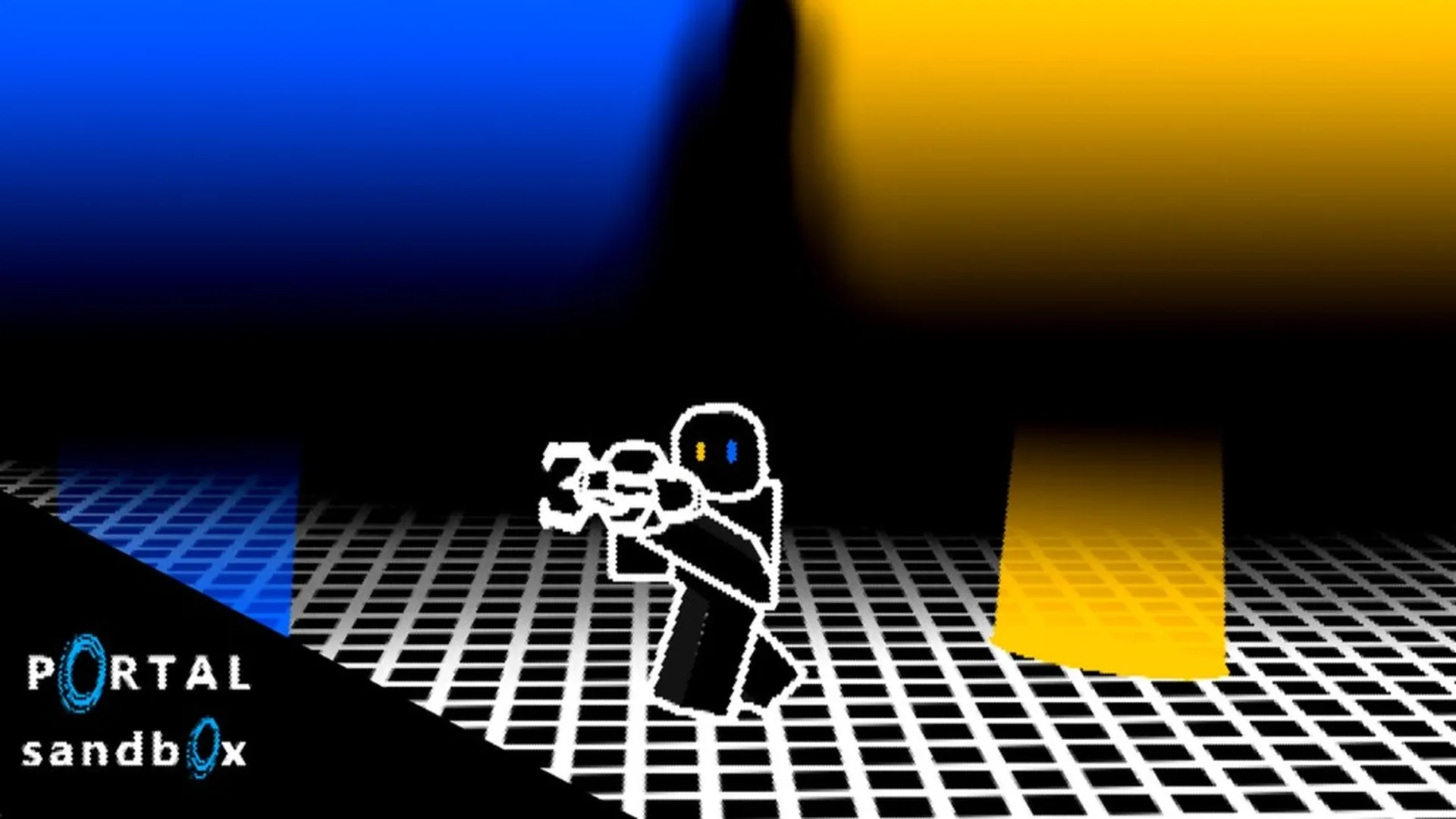
- Portal Sandbox speedrun: Use a short, repeatable route instead of exploring every available area.
- Fast setup: Equip the portal gun, choose nearby surfaces, and place both portals before moving.
- Best practice: Record attempts by route time, missed placements, resets, and unnecessary movement.
- Core skill: Improve portal angles and exit positioning before attempting complex physics routes.
- Reliable goal: Build consistency first, then optimize individual sections of the route.
Portal Sandbox speedrun Route Basics
A Portal Sandbox speedrun works best as a self-imposed movement challenge built around repeatable portal setups. Portal Sandbox is an open-ended Roblox sandbox experience rather than a traditional campaign with a confirmed official speedrun category. That means the most useful approach is to define a route, set clear start and finish points, and compare attempts under the same rules.
Start with a compact route that uses nearby floor and wall surfaces. This keeps portal placement easy to read and makes mistakes simple to diagnose. Once the route becomes consistent, add elevation changes, object transfers, or alternate portal layouts.
The official Portal Sandbox Roblox game page should remain the primary place to check the currently available experience and access details.
| Route Element | Recommended Setup | Why It Matters |
|---|---|---|
| Start point | Use a visible landmark or spawn-area position | Makes every attempt begin consistently |
| Portal one | Place it on a nearby flat surface | Reduces early placement errors |
| Portal two | Connect to a clearly marked destination | Makes exit timing easier to judge |
| Finish point | Choose a fixed object, room, or landmark | Creates a measurable endpoint |
| Reset rule | Restart after a major missed placement | Keeps comparisons fair |
Video Highlights:
- No verified Portal Sandbox video is available for embedding in this guide.
- The route below is designed for repeatable practice rather than a fixed official leaderboard.
- Use the live Roblox experience to confirm current mechanics before serious attempts.
Choose a route that can be completed with a small number of portal replacements. A shorter route with consistent placement is more useful than a longer route filled with reset-heavy tricks.
Beginner Route
- Two nearby portal surfaces
- Short walking distance
- No object manipulation
- Best for learning timing
Intermediate Route
- Floor-to-wall transition
- One elevation change
- Fixed landmark checkpoints
- Good for comparing exit angles
Advanced Route
- Multiple portal layouts
- Object or physics interaction
- Planned replacement points
- Higher reset risk
Step-by-Step Speedrun Setup
Before timing an attempt, establish the rules and prepare the environment. A speedrun route becomes difficult to evaluate when the starting position, portal locations, or reset conditions change between attempts.
The following setup is designed for players who want to practice movement, portal placement, and route consistency using only mechanics that work in the live game.
Choose a fixed starting position
Select a visible location that can be reached consistently after loading into the experience. Use a landmark, floor marking, wall edge, or other recognizable feature. Do not begin timing while still searching for the route.
Equip the portal gun
Locate and equip the portal gun before starting the timer. Confirm that the tool is ready, then position the camera toward the first target surface. Preparation should happen before the timed attempt.
Place the first portal
Aim at a nearby compatible surface and place the first portal. Flat floor or wall sections are usually easier to read than irregular geometry. If the placement is visibly poor, reset early instead of carrying the mistake forward.
Place the second portal
Place the second portal at the planned destination surface. Keep the route short during early practice. The goal is to learn how entry position, exit orientation, and movement direction affect the next section.
Move through and confirm the finish
Enter the route, follow the planned movement line, and stop at the selected finish landmark. Record the attempt only when the route follows the same rules as previous runs.
| Setup Check | Ready Condition | Common Mistake |
|---|---|---|
| Starting point | Same landmark used every attempt | Starting from a different camera position |
| Portal gun | Equipped before timing begins | Searching for the tool during the run |
| First surface | Visible and compatible | Aiming at an irregular surface |
| Exit location | Easy to recognize | Choosing a destination without a landmark |
| Timer rule | Same start and stop points | Changing the timing rule between attempts |
Do not compare attempts that use different start points, route layouts, or reset rules. Consistent conditions matter more than a single unusually fast run.
Portal Placement and Movement Optimization
The largest time savings usually come from reducing hesitation. Portal Sandbox rewards players who can decide where to place a portal before stopping to inspect every possible surface. Practice the route slowly first, then remove pauses one at a time.
Focus on the relationship between the entry portal and the exit portal. A portal can be technically correct but still create a poor route if the player exits facing the wrong direction or lands too far from the next target. Use short experiments to isolate one variable at a time.
| Optimization Area | Practice Method | Improvement Target |
|---|---|---|
| Aim control | Place portals on the same surface repeatedly | Fewer failed placements |
| Exit angle | Change the destination orientation | Cleaner movement after exiting |
| Camera control | Keep the target surface centered | Less correction before placement |
| Route length | Move the destination closer | Faster travel between sections |
| Portal replacement | Reposition only the needed portal | Fewer full-route rebuilds |
Reduce Hesitation
Decide the next surface before entering the previous portal. Pre-planned movement prevents unnecessary stops and camera searching.
Use Landmarks
Place route checkpoints near visible objects or corners. Clear landmarks make missed exits easier to identify and correct.
Practice One Variable
Change only the portal angle, height, or approach speed during a test. This makes successful improvements easier to repeat.
A useful training pattern is to divide the route into sections:
- Section A: Setup — reach the start point and equip the portal gun.
- Section B: First connection — place the initial portal without excessive camera movement.
- Section C: Transfer — enter the connection and stabilize movement after exiting.
- Section D: Final approach — reach the finish landmark using the planned path.
- Section E: Reset review — identify whether the loss came from aim, movement, or route design.
Keep a route change only when it improves multiple attempts, not just one lucky run. Repeatability is the foundation of a useful speedrun strategy.
Physics Routes, Resets, and Advanced Practice
Physics-based routes can create more interesting challenges, but they also introduce more variables. Object position, approach speed, portal height, exit direction, and available landing space may all influence the result. Treat these routes as experiments before treating them as serious timed segments.
Start with a safe object-transfer test. Place one portal near an interactable object and the second in a marked destination area. Observe where the object appears, then repeat the test after changing only the exit orientation. This method helps separate reliable behavior from accidental movement.
| Advanced Test | Required Elements | Main Risk | Practice Goal |
|---|---|---|---|
| Object transfer | Portal gun, movable object, two surfaces | Object stops or shifts position | Deliver the object to a marked area |
| Height route | Lower entry, elevated exit, safe landing space | Exit movement becomes inconsistent | Compare landing direction and distance |
| Route loop | Several surfaces and clear landmarks | The route becomes difficult to reset | Create a repeatable circulation path |
| Multi-route test | Multiple destinations | Portal replacement causes confusion | Switch between planned routes efficiently |
Use resets as part of the rules rather than as an emotional reaction. A reset is appropriate when:
- A portal attaches to an unintended surface.
- The player misses the planned entry path.
- An object leaves the intended test area.
- The camera position makes the next placement unclear.
- The route no longer matches the selected timing format.
Speedrun Practice Checklist:
- Choose one fixed start point and one fixed finish point
- Record the portal layout before timing serious attempts
- Practice the route slowly until every transition is understandable
- Track missed placements and unnecessary movement after each run
- Change one route variable at a time during optimization
Use a private server when you need an uninterrupted testing space. It can help with solo experiments, repeatable layouts, and small-group route comparisons, subject to the current Roblox experience settings.
Rules, Tracking, and FAQ
A personal leaderboard is more useful when every result follows the same format. Record the date of the attempt, route version, timing rule, number of resets, and whether the run used object or physics interactions. Since Portal Sandbox does not have a confirmed official speedrun ruleset in the supplied information, label results as personal or community challenges rather than official records.
| Record Field | Example Format | Purpose |
|---|---|---|
| Route name | Floor-to-Wall Route | Identifies the challenge |
| Version | Route A, Layout 2 | Separates layout changes |
| Start rule | Timer begins at first movement | Keeps attempts comparable |
| Finish rule | Stop at the marked destination | Defines completion |
| Reset count | 0, 1, or 2 | Shows consistency |
| Notes | Missed exit angle | Explains time loss |
For more reliable improvement, review the slowest section instead of focusing only on the final time. A route that loses most of its time during the first portal placement needs aim practice. A route that slows after exiting needs better orientation or a shorter destination path.
Q: What is the best Portal Sandbox speedrun route for beginners?
A short route using two nearby compatible surfaces is the best starting point. Use a fixed landmark as the finish and avoid object physics until basic placement becomes consistent.
Q: Does Portal Sandbox have an official speedrun leaderboard?
No official leaderboard or standardized speedrun category is confirmed in the available information. Treat timed routes as personal or community challenges unless an official ruleset is published.
Q: How can I make portal placement faster?
Plan the target surface before aiming, keep the camera centered, and practice the same placement repeatedly. Faster movement should come after consistent placement.
Q: Should I use physics tricks in a speedrun route?
Use physics tricks only after the basic route is reliable. Object transfers, height changes, and looping layouts can save time, but they may also introduce more variables and resets.
The strongest Portal Sandbox speedrun strategy is a repeatable route with clear rules, simple portal geometry, and measured improvements. Build consistency first, then add advanced movement or physics challenges.